

Uisge Beatha
“Uisge beatha” is the original Scots Gaelic term for whisky, meaning “water of life,” derived from the Latin aqua vitae. Only used when the speaker wants to sound pretentious.
Stories and rants from the world of whisky
What Is a Whisky Bonder?
Published 26/02/2026
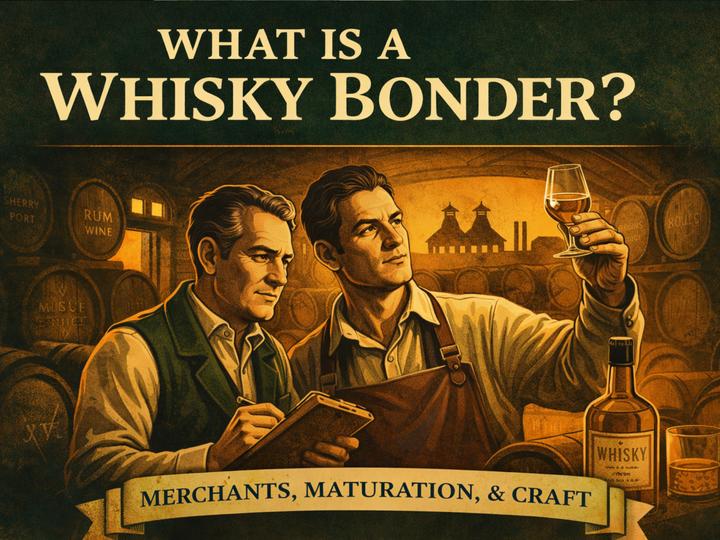
A whisky bonder is a merchant or independent specialist who sources new-make or young spirit from distilleries, matures it in their own casks, and blends and bottles proprietary expressions. Historically, bonders were often grocers, wine merchants, or publicans who used access to fortified wine and spirit casks to shape local whisky styles. Unlike independent bottlers who typically purchase mature casks, bonders actively manage maturation and wood policy. Modern bonders revive this tradition by sourcing whisky from multiple distilleries, aging it in diverse casks, and creating bespoke small-batch releases that emphasize flavour development through maturation. What Is a Whisky Bonder? Or, how merchants, patience, and a great deal of wood once determined what ended up in your glass
What Is a Whisky Bonder?
How Geographic Indications Protect Scotch Whisky
Published 11/12/2025
Whisky benefits from Geographical Indication (GI) protection because a GI legally restricts the use of the term “Scotch whisky” to spirit that is produced, distilled, and matured in Scotland according to defined standards. GI protection prevents misleading use of the name, preserves product authenticity, maintains consumer confidence, and safeguards cultural and economic value linked to Scotland. If you listen on a still Scottish night, ideally with firelight flickering like old stories on the walls and a dram warming your hands, you might notice a whisper of parchment shifting. That soft sound belongs to the Geographical Indication stirring from another long, watchful doze. It is not a monster, though some have treated it as such, and it is not a warlock, though it can make entire industries vanish from courtrooms. What it is, is a properly Scottish bit of legal folklore mixed with a national refusal to let anyone muck about with things that ought to be done right.
How Geographic Indications Protect Scotch Whisky
Why Whisky Comes in Glass Bottles
Published 10/12/2025
Whisky is packaged in glass because glass is chemically inert and suitable for long-term storage of high-proof alcohol without leaching, corrosion, or flavour alteration. High-strength spirits can react with or extract compounds from many metals and plastics, making cans and most plastics unsuitable for preserving flavour stability, especially over years or decades. Aluminum cans are also incompatible with high-proof spirits due to corrosion risks unless coated, and coatings are not designed for long maturation periods. Plastics approved for short-term contact with spirits (e.g., miniatures, transport containers) are not appropriate for long-term retail packaging because ethanol permeation and additive migration can occur.
Why Whisky Comes in Glass Bottles
Ankerstock: A Forgotten Scottish Christmas Bread
Published 26/11/2025
Ankerstock was a large, sweetened rye loaf once sold in Edinburgh during the Christmas season through the Daft Days between Christmas and New Year. Flavoured with caraway seeds and candied orange peel, it was unusual in Scotland both for its use of rye and for its Scandinavian origins. The name derives not from ship anchors but from anker, an old Dutch and Scottish unit of measure associated with bulk provisions. Closely related to the Swedish Ankarstock, the bread represents a rare survival of northern European food culture embedded in Scottish winter festivity. What Was Ankerstock? Ankerstock was a large, sweetened rye loaf seasoned with caraway seeds and candied orange. Ankerstock (often spelled anchor-stock or ankerstoke in older sources) was described by the Rev. Dr John Jamieson in his Etymological Dictionary of the Scottish Language (1808) as:
Ankerstock: A Forgotten Scottish Christmas Bread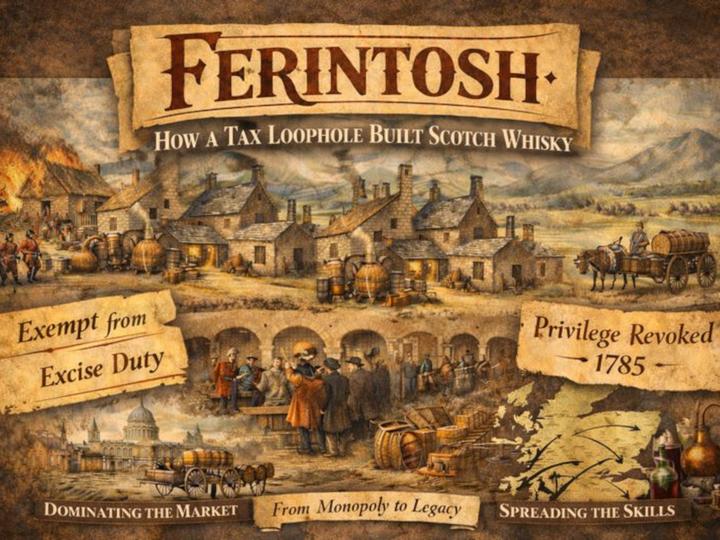
Ferintosh: How a Tax Loophole Built Scotch Whisky
Published 26/11/2025
Ferintosh was not an ancient distillery but a late-seventeenth-century Highland estate operation that became disproportionately influential because it alone was granted perpetual exemption from excise duty on distilled spirits. This privilege, awarded in 1690 as compensation for Jacobite destruction of the Forbes family estates, allowed Ferintosh to produce whisky legally and cheaply on an industrial scale. By the 1780s it accounted for over a third of all legal Scotch, supplied London rectifiers, and undercut every taxed distiller in Scotland.
Ferintosh: How a Tax Loophole Built Scotch Whisky
What’s the Difference Between Bourbon and Rye Whiskey?
Published 26/11/2025
Bourbon and rye whiskey are two major American whiskey styles defined primarily by their grain composition. Bourbon must be made in the United States from a mash of at least 51% corn, aged in new charred-oak containers, distilled below 80% ABV, and entered into the barrel below 62.5% ABV. Rye whiskey must contain at least 51% rye grain and follows the same distillation and barreling limits. Both must be bottled at a minimum of 40% ABV. Their differing grain makeup leads bourbon to taste generally sweeter and fuller, while rye tends to be drier and spicier. Legal Definition of Bourbon Bourbon is a whiskey made in the United States from a mash that is at least 51 percent corn and aged in new charred oak barrels. Bourbon must also be distilled below 80 percent ABV and enter the barrel below 62.5 percent ABV. These are not guidelines or friendly suggestions. These are Rules. Hard limits. The sort written down by stern individuals who believe the universe would fall apart if people were left to their own fermenting devices. They carry clipboards. Their spectacles glint ominously.
What’s the Difference Between Bourbon and Rye Whiskey?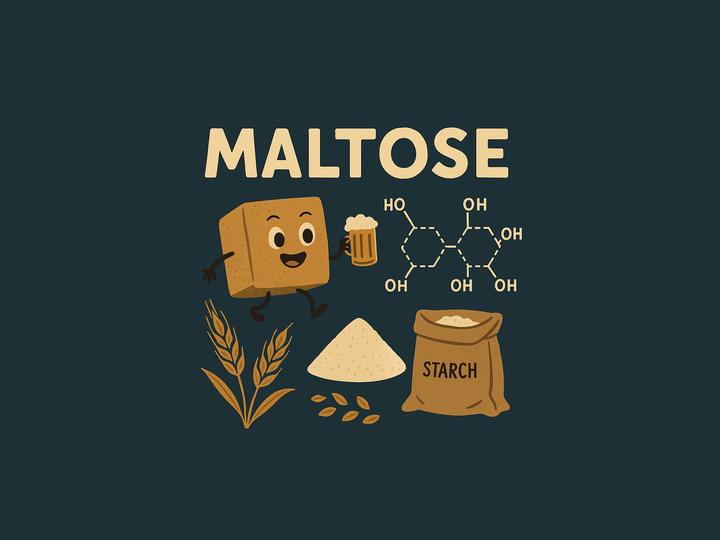
Understanding Maltose, the Sugar That Makes Whisky Possible
Published 19/11/2025
Maltose is a sugar made from two glucose units that forms when enzymes break down the starch in malted barley during mashing. It is the main fermentable sugar in wort and the key fuel for yeast. Yeast consumes maltose and turns it into alcohol and carbon dioxide. If there is not enough maltose the wash will not ferment properly and whisky cannot be made. Human beings have always been peculiarly vulnerable to sugar, especially after it decides to undergo that astonishing biochemical career change and become alcohol. This is the central thesis behind the drunken monkey hypothesis which proposes that long before civilisation had the foresight to invent pubs, our remote ancestors were enthusiastically pursuing anything that smelled encouragingly of fruit, fermentation, and highly questionable life choices.
Understanding Maltose, the Sugar That Makes Whisky Possible
The Unsung Hero of Heavy Whisky: Or, How the Worm Turned
Published 12/11/2025
Worm tubs are the whisky industry’s stubborn survivors: huge, awkward, and gloriously inefficient copper coils that condense vapour into spirit by brute chill rather than refined design. Once common, they’ve all but vanished in favour of modern condensers, yet a devoted few distillers keep them alive, convinced that only a worm tub can give whisky its signature heft, sulphur edge, and old-world soul. Picture it: a massive vat of freezing water, the sort of thing you’d only step into if you’d lost a bet, with a copper coil inside pretending to be a snake that’s recently eaten a distillery apprentice. The hot vapor from the still creeps in, meets the copper, has a brief existential crisis about being a gas, and comes out the other end as liquid again, slightly embarrassed by the whole experience. It’s simple, ancient, and just the right amount of insane.
The Unsung Hero of Heavy Whisky: Or, How the Worm Turned
The Great Scotch Whisky Swindle
Published 09/11/2025
The Scotch whisky industry is under threat from fraudulent cask investment schemes that sell overpriced teaspooned, or even non-existent barrels to unwary buyers. Poor documentation, misleading advertising, and weak regulation have left thousands at risk. Tighter oversight and transparency is needed, to stop an unsuspecting public from being conned. Scotch whisky is an industry built on patience. The sort of patience that makes monks look impulsive, glaciers look hurried, and people waiting for their printer to cooperate look positively zen. Unfortunately, it is now under siege from people who believe that “ageing gracefully” is a process that can be completed during the time it takes to make a microwave lasagne.
The Great Scotch Whisky Swindle
The Keepers of the Quaich: Basically a ‘Whisky Knighthood’
Published 05/11/2025
The Keepers of the Quaich is an invitation-only society founded in 1988 to recognize people who have made significant contributions to Scotch whisky. With about 2,800 members from over 100 countries, it holds formal induction banquets twice a year at Blair Castle in Scotland. Members must have at least seven years in the whisky world, and select veterans are later elevated to the title of Master of the Quaich. The group’s symbol is the traditional two-handled whisky cup, and its motto translates to “Water of Life Forever.” Scotland, being a land of mist, ancient stone and weather that has never once apologised, has created many traditions. Some of them are useful, like wearing wool because the alternative is hypothermia. Some are proudly symbolic. And some fall into that awkward middle category where everyone nods gravely and pretends they absolutely understand what’s going on, while quietly praying no one asks them to explain it.
The Keepers of the Quaich: Basically a ‘Whisky Knighthood’