

Whisky Fundamentals
A Short History of Beer
Published 19/08/2025
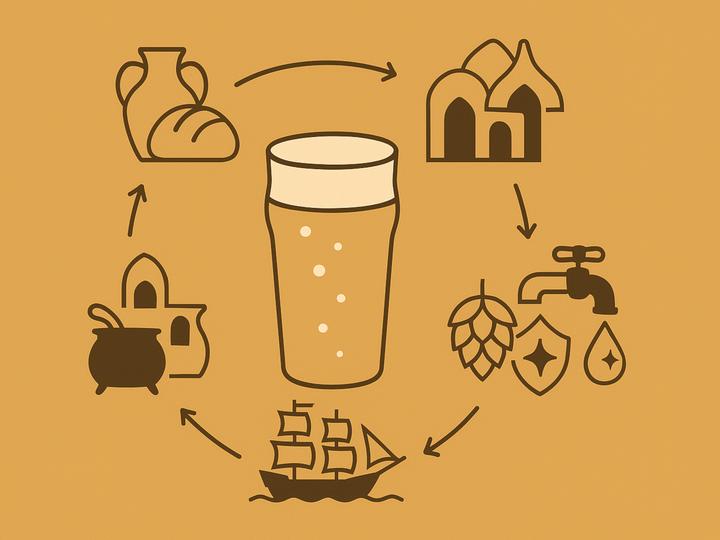
Before copper stills and dunnage warehouses, there was hot mash and cool fermentation. For much of urban history, beer wasn’t just a treat; it was infrastructure-a reliable daily drink when town water could be suspect. This is a historical sketch of how that came to be, and how IPA later extended beer’s keeping power for long journeys. 1) Ancient beginnings: bread you can drink In the grain cultures of Mesopotamia and Egypt, beer sat on the bread-beer continuum. Cereal mashes were heated, fermented, and consumed fresh. The important bit for safety wasn’t a theory of germs (no one had that yet)-it was process:
A Short History of Beer
The Bread-Beer Continuum
Published 19/08/2025
The Bread-Beer Continuum Long before modern breweries, grain-eating cultures treated porridge, bread, and beer as points on a single spectrum rather than separate foods. Heat a mash a little longer, bake it, or ferment it-each choice traded texture for shelf life, flavour, and portability. This is the bread-beer continuum in a nutshell, and it sets the stage for the wider story in Beer: A History and the evolutionary angle of the Drunken Monkey Hypothesis.
The Bread-Beer Continuum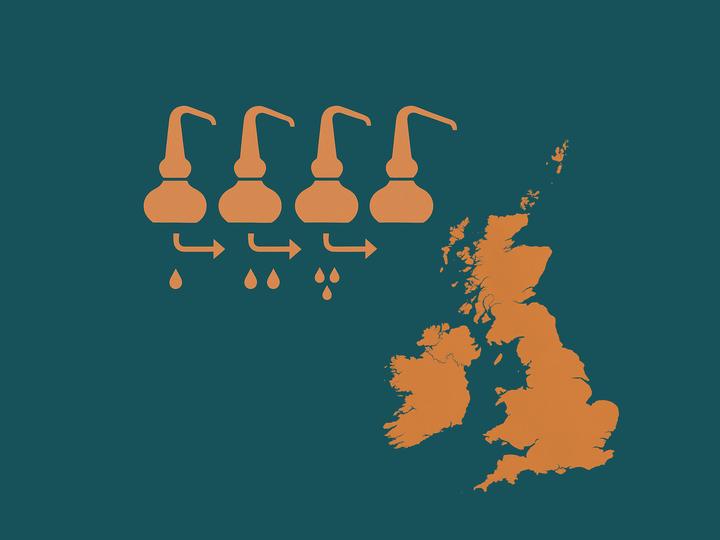
Quadruple distillation & Bruichladdich X4
Published 15/08/2025
New to the basics? Start with Whisky production, then the hardware primers on Pot stills, Condensors, and the Spirit safe. For context, compare with Double distillation, Triple distillation, and Mortlach’s selective “2.81 times” in The Wee Witchie. If you’re thinking about columns, see Continuous distillation and What is a Coffey still?. What is quadruple distillation? In batch (pot-still) whisky-making, quadruple distillation means the spirit is effectively run four times through copper. A simple schematic looks like: Wash still → low wines (~20-30% ABV). Intermediate still → “strong low wines” / intermediate spirit (ABV rises; heavy volatiles pared back). Spirit still 1 → high wines (cleaner, higher-strength spirit). Spirit still 2 → final new make (very high take-off strength; only the heart is kept). Some distilleries can achieve a “fourth pass” by routing fractions (e.g., feints or weak cuts) back through selected stills, but the goal is the same: increase purity and alter the congener mix beyond what double or triple regimes deliver.
Quadruple distillation & Bruichladdich X4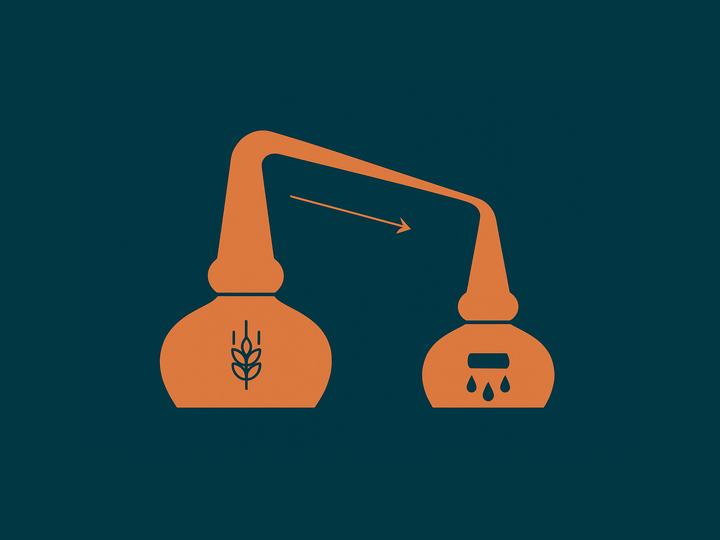
Double distillation
Published 15/08/2025
New to the basics of making whisky? Start with Whisky production, then see hardware primers on Pot stills, Condensors, and the Spirit safe. For contrasts, compare with Triple distillation, Mortlach’s selective triple stream in The Wee Witchie & 2.81, and plate columns under Continuous distillation and What is a Coffey still?. What is double distillation? In batch (pot-still) whisky-making, distillation sits between fermentation and maturation. A conventional double distillation has two main runs: Wash still → low wines Fermented wash (~7-10% ABV) is heated; alcohol-rich vapours rise, condense, and are collected as low wines (typically ~20-30% ABV). Spent wash (pot ale) remains in the pot.
Double distillation
Mortlach’s ‘2.81 times’: the Wee Witchie and an old-school Speyside distillation
Published 15/08/2025
New to the production steps? Start with Whisky production and the basics of Pot stills. For how condensers change texture, see Condensors. Curious how this differs from plate columns? Compare with Continuous distillation. The headline: what does “2.81 times” distillation mean? At Mortlach the spirit isn’t simply double distilled in a neat wash-then-spirit sequence. Instead, the stillhouse splits the output of the wash stills into multiple streams, redistills them on different spirit stills, and then recombines them.
Mortlach’s ‘2.81 times’: the Wee Witchie and an old-school Speyside distillation
Triple distillation: What are triple distilled whiskies?
Published 15/08/2025
New to the basics of making whisky? See our overview of the Whisky Production Process. If you’re comparing batch (pot) runs to columns, read our guide to Continuous distillation for how reflux and plate count “dial in” purity. What is triple distillation? In batch (pot-still) whisky-making, distillation sits between fermentation and maturation. A conventional double distillation has two main runs: Wash still: Fermented wash (~7-10% ABV) is distilled to low wines (~20-30% ABV). Spirit still: Low wines plus feints are redistilled; the distiller cuts heads, heart (new make), and tails, typically yielding ~68-72% ABV spirit for cask. A triple distillation inserts one more redistillation step (or its equivalent): low wines are distilled to an intermediate spirit, then that spirit is distilled again in a spirit still. Some sites run three distinct pots; others recycle portions (like feints) strategically so that, functionally, the heart has been distilled three times.
Triple distillation: What are triple distilled whiskies?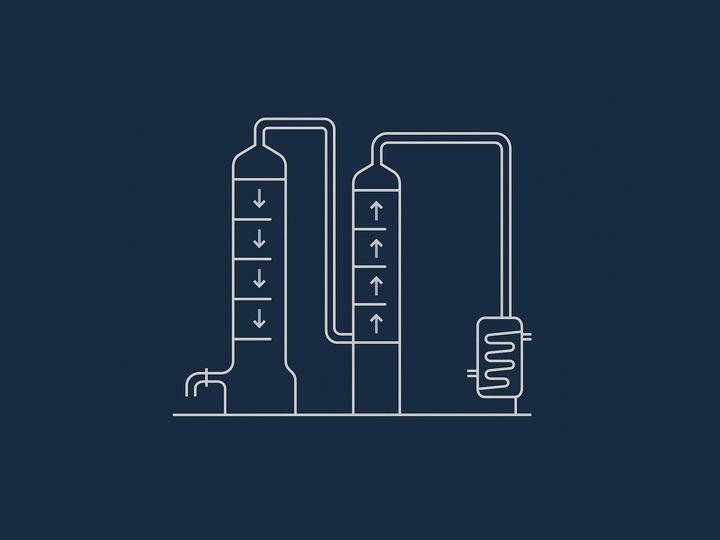
Continuous distillation
Published 12/08/2025
Columns are the workhorses of modern spirits: fast, steady, and tunable. While pot stills craft character in batches, continuous distillation separates components in a steady state, giving producers precise control of purity and flavour all day, every day. New to the basics of making whisky? See our overview of the Whisky Production Process. What is continuous distillation? Continuous distillation feeds fermented wash/beer into a heated column while vapour rises and liquid flows downward. On each tray (or within packing), rising vapour and falling liquid repeatedly exchange components. Lighter volatiles (ethanol, light esters) enrich as they climb; heavier ones (water, fusels) enrich as they descend. Product is drawn off at controlled strengths while spent liquid leaves the base. Because feed and take-off are continuous, plants run stably for days.
Continuous distillation
Pot stills in whisky
Published 12/08/2025
Pot stills are the classic, batch distillation vessels that shape many of the world’s most characterful whiskies. If column stills are about efficiency and consistency, pot stills are about selective concentration-using copper, heat, and time to gather congeners (flavour compounds) into a style. What is a pot still? A pot still is a closed copper kettle that boils a fermented wash (or beer) so alcohol-rich vapour rises, travels through a neck and arm, and is condensed back to liquid. Each run is discrete: you charge the still, heat, make your cuts (heads/hearts/tails), and empty-then repeat.
Pot stills in whisky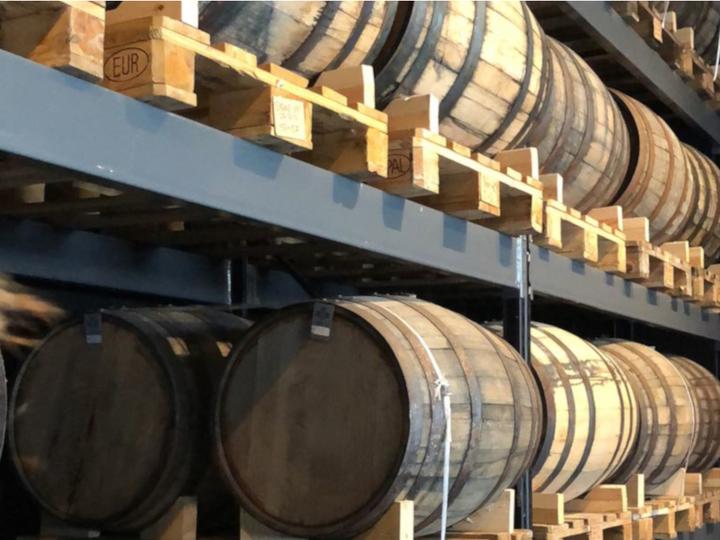
What is single cask whisky?
Published 13/07/2025
A Single cask, or single barrel whisky, is any whisky produced from aging in a single barrel without blending. Confusingly the name single cask whisky is also given to whiskies that mature over several barrels sequentially. Which is to say what a whisky may be aged in and seasoned by several casks and still be called a single cask, so long as it is not the result of mixing the content of different casks together. While it is not guaranteed, most single cask whiskies are bottled non-chill filtered, without caramel and bottled at cask strength.
What is single cask whisky?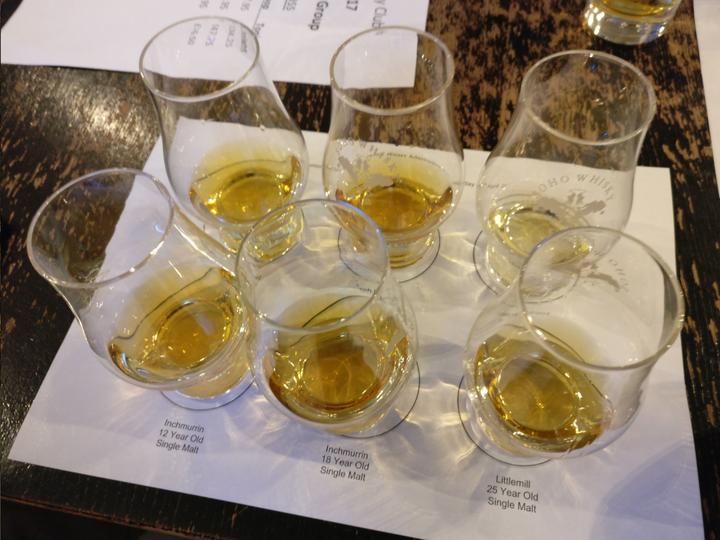
Whisky and Food Pairing: A Match Made in Heaven
Published 15/09/2023
Whisky, a beverage rich in nuances and flavors, offers a wide array of pairing possibilities with various foods, transforming ordinary meals into gourmet experiences. Whether you are a whisky aficionado or a newcomer eager to explore, this guide will help you navigate the delightful world of whisky and food pairings. The most important thing to consider before you get started is how each course must balance but also fall on to each subsequent dram. Start to peaty and you won’t enjoy the whiskies to follow, start with too premium and delicate a dram and you may overshadow those accompanying later courses.
Whisky and Food Pairing: A Match Made in Heaven